
Fire Escape Welding Westchester provides on-site structural welding, steel repair, and connection reinforcement for apartment buildings, co-ops, and commercial properties. We repair cracked welds, failed joints, and corroded fire escape steel throughout Westchester County.
We provide on-site structural welding and steel repair for co-ops, apartment buildings, and commercial properties throughout Westchester County, including:
Every municipality enforces property maintenance codes through its own local building department and fire marshal. We perform fire escape welding repairs with applicable safety requirements in mind and provide documentation to support inspections and building records.
A fire escape depends on its welds. When one cracks or a joint separates, the structure loses load-bearing capacity right there, not gradually. Our welding work covers:
Grinding out the failed weld and rebuilding the joint to spec, not grinding over it and re-covering with paint.
Where a fillet weld has let go and two members have pulled apart at their point of attachment.
When section loss from rust has thinned a member past what welding can restore, we cut out the piece and replace it, sometimes with a splice or gusset plate at the connection.
Adding steel at a stress point before it fails, not after. This includes welds at stair stringers and tread connections, the brackets that anchor a drop or counterbalance ladder or a gooseneck ladder, and bolted or riveted joints that have corroded or worked loose and need a permanent welded repair instead of another bolt.
The work happens on your building. We don't remove anything or ship it to a shop.
Can a fire escape be welded? Yes, in most cases. Can corroded or rusted steel be welded? Sometimes, it depends on how much sound metal is left. Thin, flaking steel with significant section loss often won’t hold a weld reliably, which is why an honest assessment matters more here than a quick yes.
This is the judgment call that matters most, and it’s the one a lot of estimates skip.
If the surrounding steel is sound and the failure is limited to the weld or joint, welding brings the connection back to full strength.
If section loss has thinned the steel below a safe thickness, welding just moves the failure point next door. We cut out the member and fabricate a new one in its place.
If failure shows up at multiple points across the structure, patch welding stops making sense. We'll say so directly and point you to a full restoration instead, rather than billing repeated spot repairs on a structure that needs rebuilding.
The deciding factor is always section loss and weldability, not what’s fastest to quote.
Not every fire escape problem is a welding problem, but these usually are:
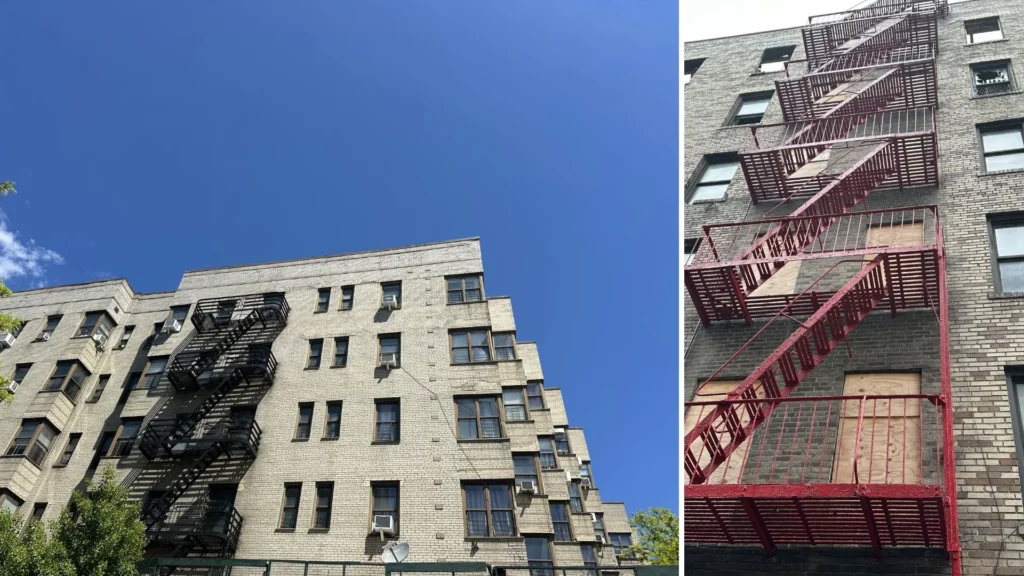
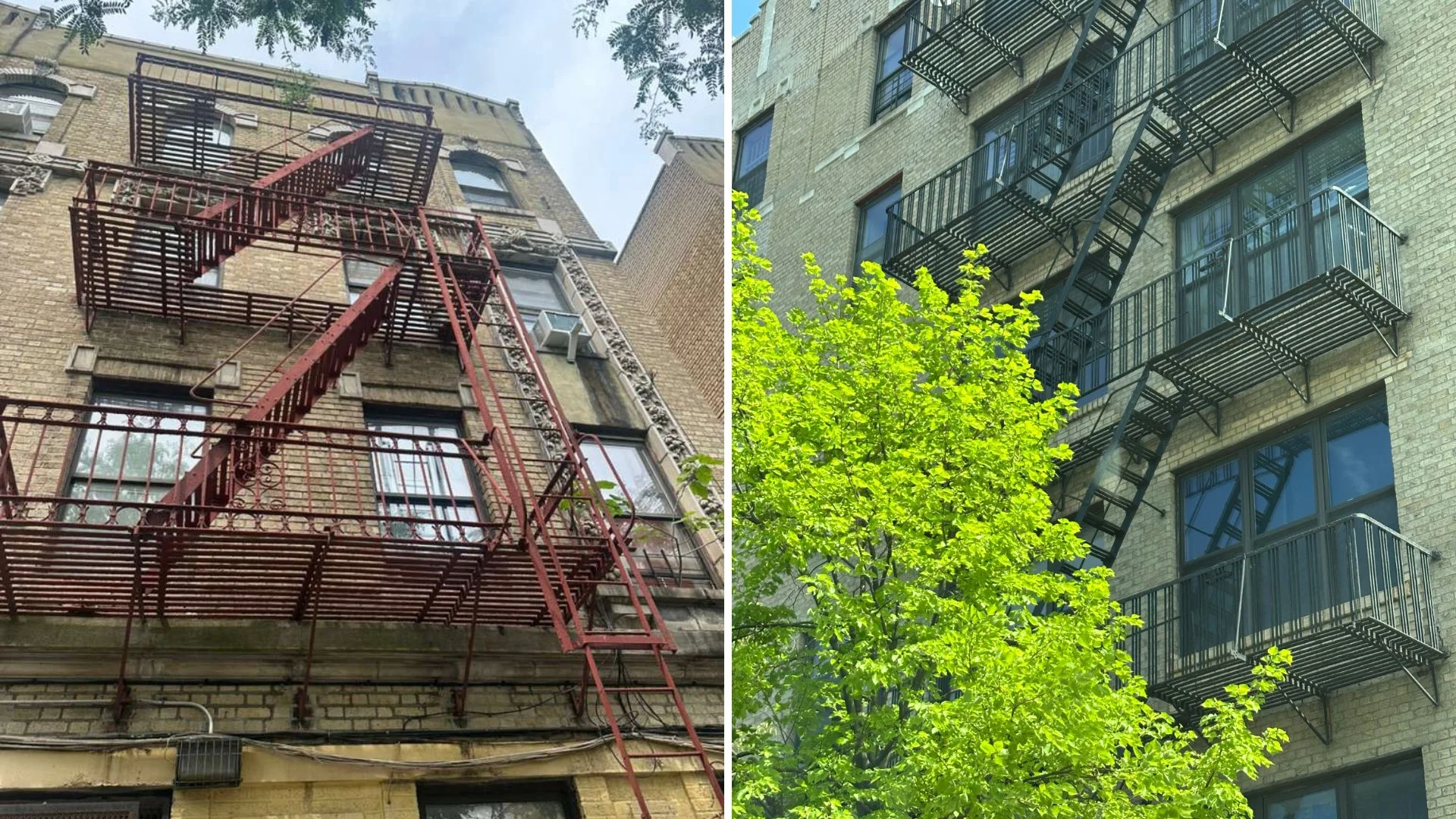
In Yonkers, Mount Vernon, and New Rochelle, where much of Westchester’s pre-war multifamily stock sits, this is the pattern we see most: decades of surface rust that finally reached the steel underneath. A cracked weld isn’t automatically an emergency, but you should have someone look at joint separation or section loss at a load point before the next inspection cycle.
Not sure which one you’re looking at? Book a fire escape inspection before committing to a repair path.
Hot work on an occupied building is a legitimate safety concern, and we treat it that way.
Timeline depends on scope. A single cracked weld or separated joint is often a same-visit repair. Member replacement or multi-point jobs run longer once fabrication is factored in, and we’ll give you a specific timeframe with your estimate.
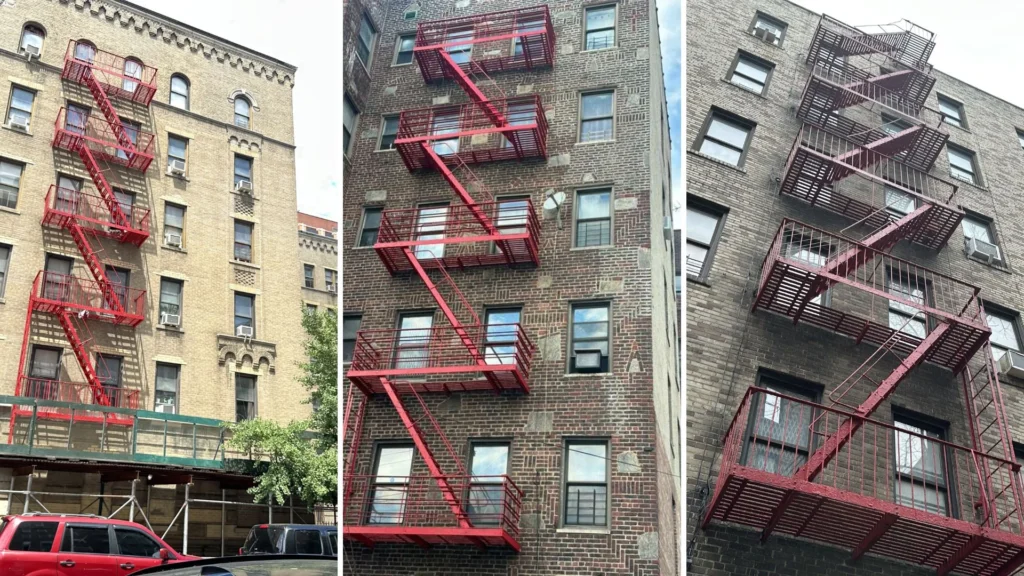
Westchester fire escapes are governed by New York’s Multiple Residence Law and the Property Maintenance Code of New York State, §304.9, enforced locally by each city’s building department and fire marshal. That’s a different framework from what applies inside New York City, and it’s worth knowing before you hire someone who quotes you a citywide code that doesn’t reach your building.
Will welding repairs help my fire escape pass inspection? Welding addresses the specific defect your inspector cited. Whether the structure passes on re-inspection is the inspector’s call, based on the whole fire escape, not just the repair. We can tell you honestly whether the weld we did meets the standard; we can’t promise a pass on your behalf.
If you’re already working with an open notice, ask us about the process for a failed inspection or violation, since it runs alongside the welding itself.
We provide repair documentation, photos, and insurance certificates when required for board approval, management records, and building files.
We carry general liability of $2M and a certificate of insurance available for boards and managers, which counts for more on hot work near tenants than it does on a paint job. In 22 years working on Westchester fire escapes, we’ve completed 600+ projects: cracked welds, corroded connections, damaged steel members, and structural failures caused by long-term exposure and previous patch repairs.
Project Examples: Add completed projects, before/after photos, and verified customer reviews here.
Boards and managers approving structural work usually want to see the credentials and project history behind it, not just a quote. We provide both before you have to ask.
If your fire escape has a cracked weld, a separating joint, or steel that’s rusted through, don’t wait for it to move under load. We’ll assess the structure and tell you plainly whether it needs welding, replacement, or a full restoration.
A weld that’s already cracked doesn’t heal itself, and a board waiting on a repair plan won’t wait forever either. Contact us at (914) 266-1401 or request an assessment.
Fire Escape Welding Westchester will check the structure and give you a straight answer on scope before you commit to anything.
Often, yes. If the surrounding steel is sound and the failure is limited to a weld or joint, welding restores full strength. If section loss has thinned the steel, the member usually needs replacement instead.
It depends on the number of joints or members involved, whether fabrication is needed, and site access. A single weld repair costs far less than a multi-point job with member replacement. Request an exact quote for your specific structure.
Yes. Our certified welders provide documentation and project records when required by boards, property managers, and building owners.
Yes, when it's done with proper site protection, containment, and a fire watch during hot work, which is standard practice on any occupied structure.
A single cracked weld or joint repair is often finished in one visit. Larger jobs involving member replacement or multiple repair points take longer, and we'll give you a specific estimate once we've assessed the structure.